
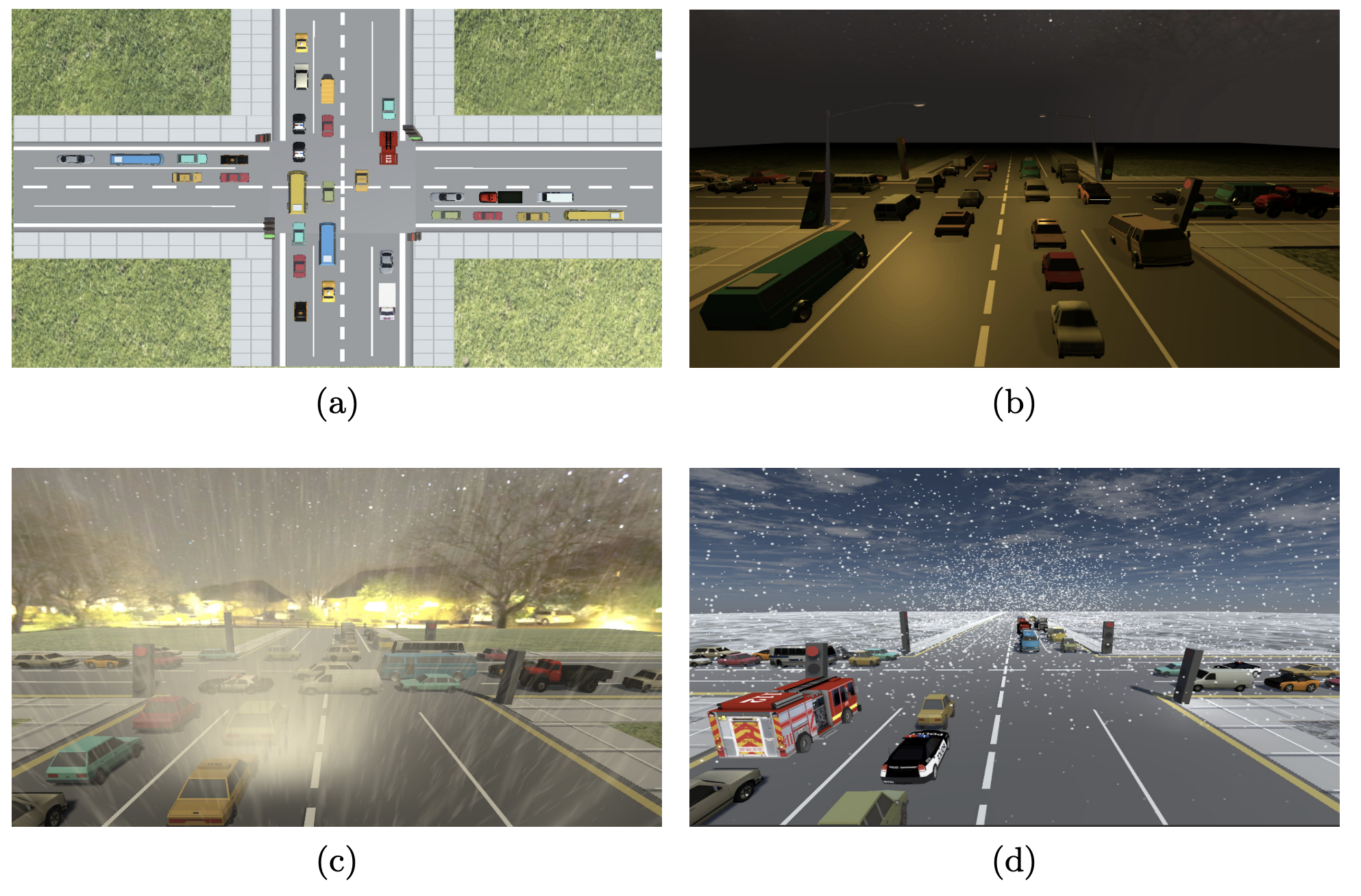
This project applies deep reinforcement learning to the adaptive, real-time control of traffic signals, with the aim of reducing congestion by letting existing signal infrastructure learn and adapt to changing conditions rather than following hand-crafted rules. End-to-end agents configure signal timings directly from the observed state of an intersection, including from live camera feeds.
A key challenge is moving such agents out of the laboratory and into the real world. The project addresses this on several fronts: Traffic3D, a rich 3D simulation paradigm built to train agents that transfer to reality; multi-agent formulations in which signals coordinate across multiple intersections to optimise aggregate flow rather than making myopic, locally-optimal decisions; and sim-to-real techniques — including domain randomisation and the synthesis of photorealistic traffic imagery with combined generative-adversarial and graph-neural-network models — to bridge the gap between simulated training and real deployment.