
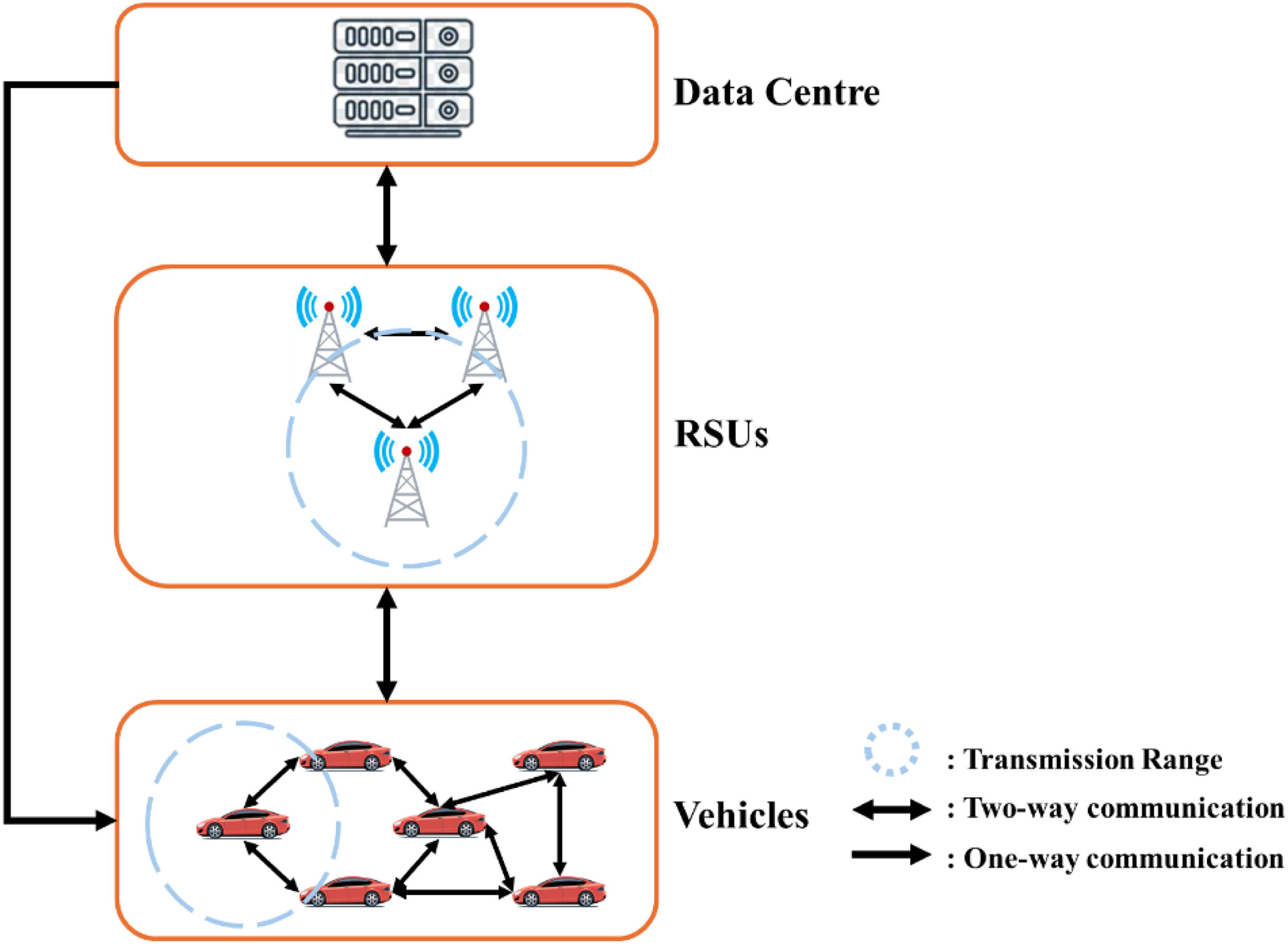
This project designs in-network content caching strategies for Vehicular Ad-hoc Networks (VANETs), where the highly dynamic topology, limited communication range and constrained on-board storage make it hard for conventional mobile ad-hoc networking methods to deliver good Quality of Service. By caching content closer to vehicles, the work aims to reduce link load and improve responsiveness for applications such as congestion control, accident warnings and real-time navigation.
The caching frameworks draw on modern networking paradigms — Software-Defined Networking (SDN) for centralised control and Named Data Networking (NDN) for content-centric delivery — and combine them with learning- and location-based methods: density- and position-based probabilistic caching, location-aware clustering, spiking neural networks, and UAV-assisted association. Together these adapt caching decisions to traffic density and topology change, targeting higher QoS in demanding urban scenarios.